








Tenants feel more secure under the Renters' Rights Act, but affordability could undo that progress. See what our 2026 report found and what agents can do.
The Goodlord team
Nov 13, 2026
By abolishing Section 21 and giving tenants greater security and flexibility, the government has addressed some long-standing concerns about renting.
Goodlord’s State of the Lettings Industry Report 2026 suggests that tenants are responding positively to the changes. 77% say they feel secure in their tenancy, and tenant optimism has reached 37%, the highest in our four surveys.
But there is another side to this picture. Having the right to stay in your home and being able to afford to stay are two different things. The report shows that tenant pessimism has crept up too, from 34% to 36%, leaving net sentiment at just +1.
This raises an important question: how much of a difference can stronger tenant rights make if they cannot afford to stay in their homes?
In this blog, we'll look at the pressures tenants face right now, and what that means for agents when rent reviews come around.
- Tenants have little financial cushion
- Landlords are preparing for regular rent reviews
- The divide between staying and finding a home
- How should agents approach rent reviews?
- Stronger tenant rights are welcome, but building more affordable homes is essential
Supply is tight, demand remains high
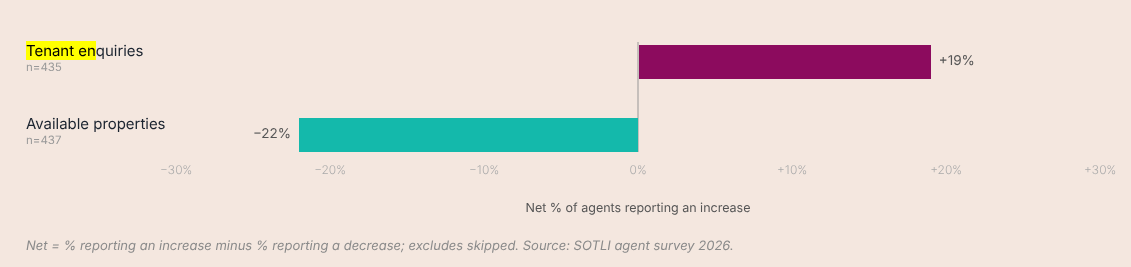
One of the main pressures on the Private Rented Sector (PRS) is the number of available homes. Half (50%) of agents surveyed report fewer rental properties are available in their markets, while 45% say tenant enquiries have risen. This means that more people are looking for homes at a time when agents have fewer properties available, putting a strain on both sides of the market.
Little evidence suggests demand for rented homes will ease quickly. 39% of tenants said they expected to stay in their current home, while another 24% planned to move to a different rental property. Only 24% say they're likely to buy within the next 12 months. In other words, many tenants expect to keep renting, putting further pressure on already stretched supply.
This is problematic when we look at landlords’ behaviour. Most (67%) haven't changed their portfolio in the past year, 27% are shrinking their holdings, and only 3% have added to it. Among those reducing their portfolios, the Renters’ Rights Act (65%), taxation changes (49%), and higher running costs (37%) are the reasons.
New building targets won't come to the rescue. The government has acknowledged that it has only a slim chance of meeting its target of 1.5 million new homes in England by the next election, so any relief from new supply is a long way off.
Tenants have little financial cushion
Increased competition for homes becomes more concerning when looked at alongside tenants’ financial circumstances.
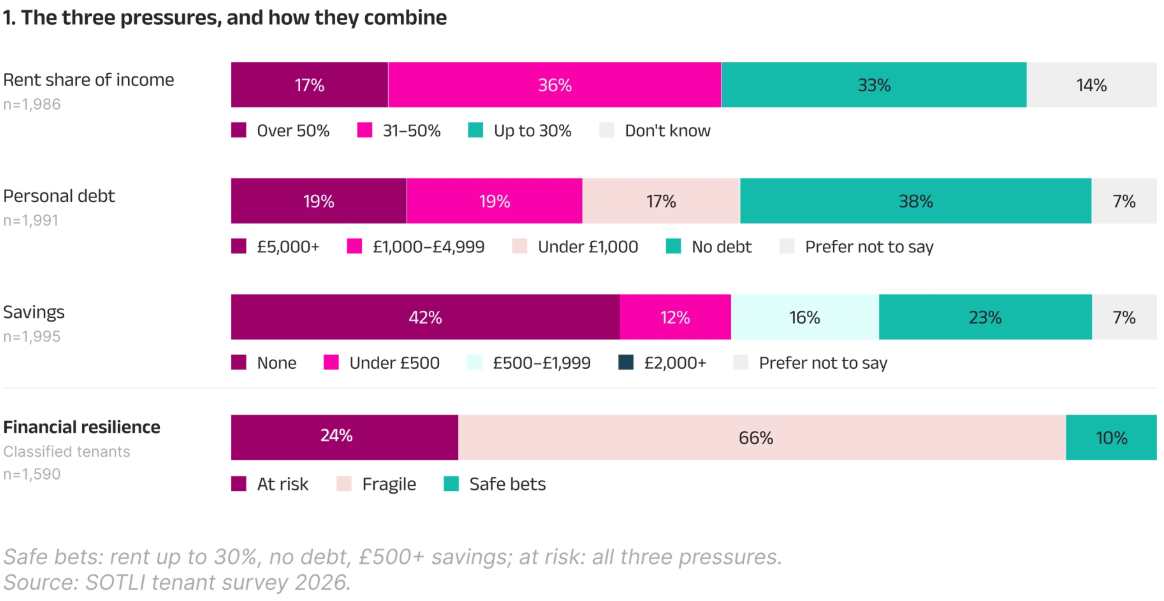
More than half of the tenants surveyed (53%) said they spent over 30% of their take-home income on rent, and for 17% it takes more than half. Financial reserves are limited too: 55% reported personal debt (excluding mortgages, student loans, and credit cards paid off in full), and 54% have less than £500 in savings they could access quickly.
This leaves many households poorly positioned to cope with rising housing costs. In fact, if faced with a 6.5% increase (in line with the increases recorded between June 2025 and June 2026), 35% of tenants say they would face financial distress and 17% say it would harm their mental health.
For tenants in that position, a further rent increase spells trouble. Staying means stretching an already tight budget further, with little savings to fall back on. Moving might mean a cheaper home, but it also means competing in a market with fewer available homes and more enquiries, while landlords are becoming more cautious about applicants with weaker credit histories.
Landlords are preparing for regular rent reviews
Landlords, meanwhile, have their own costs and decisions to weigh up, and many are planning regular rent reviews. In the survey, 42% of landlords expect to raise rents on existing tenants every year, and 28% say periodic tenancies make them more likely to use Section 13 annually.
While these are landlords’ stated intentions, not a prediction that every tenant will face a rent increase every year, they suggest regular rent reviews could become more common.
Then there's the cost of keeping homes up to scratch. Of the landlords who explained how they planned to fund EPC upgrades, which could be up to £7,000 per property, 31% hoped to recover some of the cost through rent. This means the more landlords expect to spend, the more pressure there may be on rents.
Rent rises aren’t new to tenants, of course. The difference now is what they land on. With almost half (48%) of tenants having lived in their home for four years or more, many will already have absorbed a rise or two, and they’re facing the next one with little in reserve.
The divide between staying and finding a home
The Renters' Rights Act has helped tenants who already have a home, but it risks splitting renters into insiders and outsiders. As Goodlord CEO William Reeve says, “The RRA hasn’t made all tenants winners. It has made insiders winners, whilst unwittingly making it harder to become one."
Affordability is where that divide bites. Since the ban on rent in advance, 26% of landlords say they are now more likely to reject applicants they would previously have accepted. Another 31% are more likely to leave a property empty while waiting for a lower-risk applicant.
Agents are taking the same line, with 47% recommending against applicants with poor credit histories or CCJs since the Act took effect.
Moving costs money too. Reposit has found that 27% of renters are taking on repayable debt to afford their cash deposit, up seven percentage points from a year ago. So a tenant who gives notice to escape a rent they can't afford may be swapping a known problem for an uncertain search, with little in savings to fall back on.
How should agents approach rent reviews?
A rent review is not simply about achieving the highest possible rent; it needs to balance both sides. Landlords have legitimate costs to meet, and a reasonable rent increase is part of running a let. But a review also has to weigh a tenant's capacity to pay alongside the cost and uncertainty of finding a replacement.
So, before recommending a figure, agents should consider two questions: could this tenant afford it, and what would losing them cost? This means:
- Weigh the tenant's capacity to pay: The report classifies just 10% of tenants as “safe bets.” By contrast, 24% face all three pressures, and for them a rent rise is a real threat, so affordability belongs in the conversation.
- Count the cost of a void: Among agents who reported increased tenant churn since the Act took effect, 72% say void periods have increased. This is a reminder to weigh the potential loss of rental income and cost of finding a replacement when advising on an increase.
- Help landlords plan for improvement costs: Many landlords expect upgrades to cost more than national estimates, and some hope rent will cover part of the bill. Helping them plan ahead is an opportunity for agents, and keeps rent reviews realistic, rather than landing it in a single review.
- Be ready to explain every increase: Only 43% of tenants know they can challenge an increase at the First-tier Tribunal, but 24% have already used AI to understand their rights. Clear records and sound explanations of the proposed rent will help agents respond when tenants question an increase.
Stronger tenant rights are welcome, but building more affordable homes is essential
The Renters' Rights Act has made tenants more secure, and optimism is at its highest level on record. But pessimism is rising too, as the market splits into insiders and outsiders, and the pressures on supply and household budgets help explain why.
With limited savings making both staying and moving harder, early optimism surrounding rights is likely to give way to frustration unless affordability and supply improve. Rights only count for much in a market where tenants can afford to remain and find another home when they need one.
Read the full State of the Lettings Industry Report 2026 to explore the findings in more detail and see what agents, landlords, and tenants think about the future of the PRS.