








Property licensing fines in the UK have hit £25m in London alone as councils adopt aggressive new tactics. Inside the data, council rankings and what the Renters’ Rights Act 2025 means for landlords.
Jess Hulme
May 28, 2026
Almost £25 million in fines, 4,229 cases, and a Renters' Rights Act 2025 that has just doubled Rent Repayment Orders to 24 months. Here is the data behind the latest property licensing crackdown, and the new tactics councils are using to industrialise enforcement.
Property licensing fines in the UK have entered a new era. London local authorities have now levied almost £25 million in fines against landlords and letting agents, with licensing offences alone accounting for £14.85 million, more than half the total. Behind those headline numbers lies a structural shift in how councils enforce, a record-breaking surge in the number of licensing schemes in operation, and a Renters' Rights Act 2025 that has just doubled the maximum Rent Repayment Order to 24 months' rent and raised the maximum civil penalty to £40,000.
For landlords and agents, the property licensing minefield has never been wider, deeper or more costly to misread.

The £25 million London enforcement picture
Kamma's ongoing analysis of the Mayor of London's Rogue Landlord Database, captured as of late May 2026, shows £24,125,937 in fines across 4,229 cases, involving 2,010 landlords and 1,226 properties.
Licensing offences alone account for £14.85 million of that total. Three years ago, licensing was a niche part of council enforcement. Today, it is the single biggest enforcement lever in the capital, and the gap is widening every quarter.
Letting agents are squarely in the firing line. Kamma's earlier analysis showed the average fine issued to a letting agency rose by 14.46% between November 2025 and March 2026, reaching £7,300 per offence.
A decade of expansion: From two schemes to 162
The fines are not a one-off spike. They are the downstream consequence of a decade of accelerating regulation. In 2017, Kamma's data shows just two discretionary licensing schemes operating in the UK. By 2025, that number had reached 149. With 13 schemes already scheduled or live in 2026, the count now stands at 162, and Kamma expects further launches before year-end.
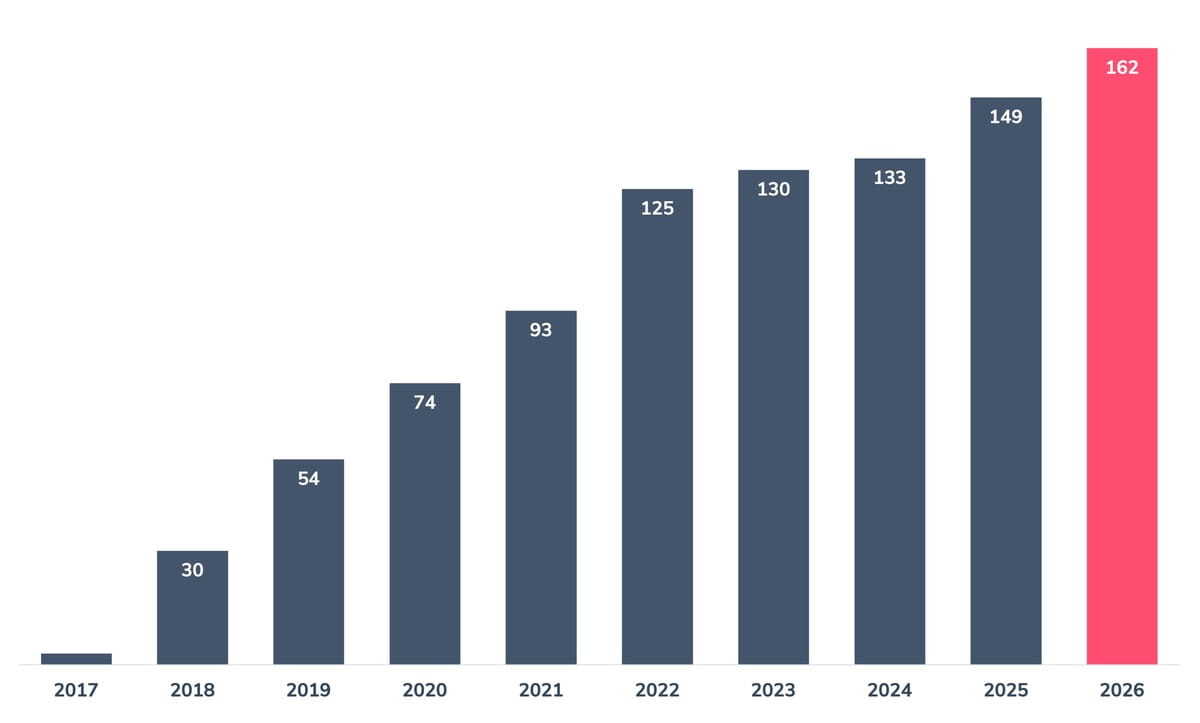
A third of all currently live schemes (33%) have launched in the past 12 months alone. The pace of change is now the most significant compliance challenge facing landlords and agents; the rules they were operating under last year may not be the rules that apply to the same property today.
Coverage is now overwhelming in the places where most of the UK's rental stock sits:
• 88% of London is covered by some form of local authority property licensing.
• 69% of urban areas across the UK sit within a licensing regime.
• 28 of 32 London boroughs now operate licensing restrictions.
Many of these schemes are scheduled to remain in force until 2031, signalling that licensing is no longer a temporary intervention. It is a permanent feature of the Private Rented Sector. This is the patchwork problem in three dimensions: more schemes, more change, and increasing geographic concentration in the very areas where landlords and agents operate most actively.
Where the biggest fines are landing
Inside London, a small group of boroughs dominate the headline numbers, but the pattern of enforcement varies sharply between them.
Three patterns stand out:
• Waltham Forest leads the capital on total fines (£5.9m from 714 cases), backed by a long-running selective licensing scheme and an experienced enforcement team.
• Camden has brought more cases than any other borough (964), but at a lower average per fine; a high-volume model focused on consistent pressure rather than headline-grabbing penalties.
• Kensington & Chelsea is in a league of its own on severity, averaging more than £108,000 per case. Its fines are driven by a smaller number of very large, high-value prosecutions targeting the most egregious offenders.
Westminster, Wandsworth, Tower Hamlets and Brent all sit between £6,700 and £8,400 in average fine per case, well above the London-wide average.
The new playbook: How councils are enforcing differently
What has changed in 2026 is not just the scale of enforcement. It is the operating model. Councils are experimenting with new tactics that turn a single licensing breach into multiple, compounding consequences for the landlord.
Tower Hamlets – Direct support for tenants
The borough provides hands-on support to tenants pursuing Rent Repayment Orders at the First-tier Tribunal, securing over £1.3 million for renters to date.
Camden & Islington – Prosecution plus tenant support in parallel
Councils prosecute landlords through the magistrates' courts and support tenant RRO claims in parallel. A conviction makes the tenant's case substantially easier, but is not a prerequisite. The result is a prosecutorial pipeline that delivers a council fine and a tenant payout from the same evidence base.
Oxford & York – Partnership model
Councils gather the evidence and partner with non-profits such as Justice for Tenants to run tribunal cases on tenants' behalf.
Bristol – Fee-fronting model
The council pays the £100/£200 tribunal fees upfront on the tenant's behalf, repayable only if the RRO claim succeeds.
Newcastle – Toolkit model
The council publishes downloadable RRO guidance, tenancy templates and licensing-status checks so tenants can self-represent with council backing.
North Lincolnshire, NE Lincolnshire, Peterborough, Reading, Great Yarmouth, Doncaster and West Lindsey - Outsourced Delivery
Third-party providers run portals, applications, inspection programmes and compliance checks at scale, allowing smaller authorities to enforce at London-borough intensity.
The common thread is industrialisation. Where enforcement once depended on the bandwidth of a small council housing team, it now runs through specialist providers, non-profits and integrated tenant-redress pipelines.
"The £25 million figure is striking, but the real story is how councils are enforcing. Camden and Islington are now running a prosecutorial pipeline that turns council convictions into near-automatic Rent Repayment Orders for tenants. Tower Hamlets is providing free legal representation. Smaller authorities are outsourcing the entire operation to firms like Capita so they can enforce at London-borough intensity." - Orla Shields, CEO, Kamma
Why the stakes just doubled: Renters' Rights Act 2025
The Renters' Rights Act 2025 came into force on 1 May 2026. For landlords and agents, three changes are immediately material:
1. Maximum civil penalties have risen to £40,000 per offence, replacing the previous £30,000 cap.
2. Rent Repayment Orders have doubled. Tenants can now claim up to 24 months of rent (previously 12), turning a single conviction into a five-figure exposure per property.
3. "Superior landlord" liability has been extended further up the chain, dragging head-leaseholders and corporate landlords into enforcement actions they previously sat behind.
The Act also introduces a mandatory national Private Rented Sector Database, designed to give councils unprecedented visibility over rented homes across England. Combined with the local licensing schemes already in operation, councils will soon have two overlapping registers identifying which properties are unlicensed, non-compliant or operating outside the rules. Kamma's analysis suggests the database will accelerate enforcement still further, not replace local licensing, but add a national layer on top.
What landlords and agents should do now
For landlords and agents operating across multiple local authorities, the message from the data is simple: manual tracking will not keep up. With 162 schemes now active, a third launched in the past 12 months and another tranche scheduled before year-end, the goalposts are moving faster than any spreadsheet-based compliance process can absorb.
Three priorities stand out:
• Audit every property against current local rules, not the rules that applied when the property was last let. A scheme that did not exist 12 months ago may now require a licence on that exact street.
• Track scheme launches and changes in real time. A property that is compliant today can fall out of compliance overnight when a council expands or replaces a scheme – a particular risk in boroughs preparing for Renters' Rights Act enforcement.
• Build an audit trail. Under the new £40,000 penalty regime, the ability to evidence due diligence is now a material asset for both landlords and the agents acting on their behalf.
How Kamma helps you stay ahead of the enforcement curve
Kamma tracks every active and upcoming property licensing scheme across the UK in real time, providing landlords, letting agents and lenders with a single source of truth on local compliance. As the regulatory landscape continues to expand – and as the £25 million London figure climbs higher with every Rogue Landlord Database update – the cost of getting compliance wrong has never been higher.
If your business operates across multiple local authorities, book a demo with Kamma to see how our licensing intelligence keeps you ahead of the enforcement curve.
Kamma is the UK's leading provider of property compliance intelligence. They track every active and upcoming licensing scheme, EPC requirement and enforcement action across the UK in real time, helping landlords, letting agents and mortgage lenders manage compliance at portfolio scale. Data is based on Kamma's proprietary analysis of discretionary licensing schemes across 361 local authorities in the UK. Fines data based on analysis of the Mayor of London's Rogue Landlord and Agent Checker (RLAC).