





Agent, landlord, and tenant confidence is recovering now that the Renters’ Rights Act rules are known. See where sentiment is strongest and what could test it.
The Goodlord team
Nov 4, 2026
Four years, two Bills and one Act. Since 2022, letting agents and landlords have been waiting to see what rental reform would mean for them in practice. Now that the Renters’ Rights Act is in force, they’re feeling less gloomy about the future of the private rented sector (PRS).
Goodlord’s 2026 State of the Lettings Industry Report, which surveyed 3,031 agents, landlords, and tenants, suggests that clearer rules may have lifted their mood, even though they remain broadly unhappy with where the sector is heading.
This recovery isn’t uniform, however. It varies by agency staff size, landlord portfolio size, and tenant age. In this blog, we’ll look at how the sentiment has changed, why different groups see the future of PRS differently, and whether the next phase of reform could put this renewed confidence to the test.
-
The PRS Sentiment Index revealed that pessimism is easing
- Sentiment changes with scale
- Confidence in any political party remains low
- Can the sector hold onto its improved sentiment?
The PRS Sentiment Index revealed that pessimism is easing
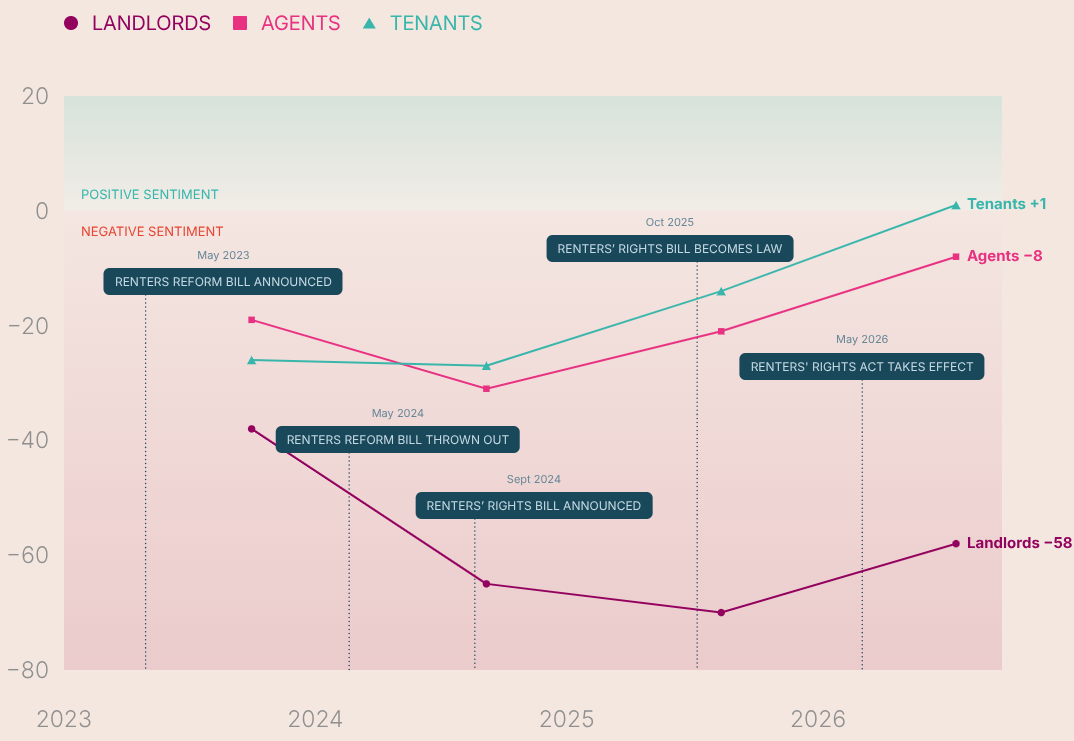
The PRS Sentiment Index measures net sentiment: the percentage of respondents who feel optimistic minus the percentage who feel pessimistic. In other words, a score below zero means pessimists outweigh optimists. To understand how these figures have changed, it's worth viewing them in the context of rental reform.
In June 2022, the Conservative government published its A Fairer Private Rented Sector white paper, before introducing the Renters Reform Bill to Parliament in May 2023. Our first sentiment readings, taken that year, suggested unease across the sector, with landlords the most negative group (−38), followed by tenants (−26) and agents (−19).
The Renters Reform Bill then failed to reach Royal Assent before the May 2024 general election, leading to widespread uncertainty. Labour introduced its replacement, the Renters' Rights Bill, that September. Our 2024 readings captured the aftermath: agents reached their nadir (−31), landlords fell furthest (from −38 to −65), and tenants remained largely unmoved (−27).
By our 2025 reading, taken before the Bill became law, agent sentiment had recovered to −21, but landlords had reached their lowest point in the series, with a score of −70. In the same year’s survey, 80% of landlords expected the abolition of Section 21 to hurt their business.
The Renters' Rights Act took effect on May 1, 2026, and by our August survey, sentiment had improved across all three groups. Agents reached −8, their best reading in the four years. Landlords improved to −58, although they remain considerably more pessimistic than they were in 2023. Tenants reached +1, the first time any group has moved into net positive territory.
So while agents and landlords are less pessimistic than last year, neither group is optimistic overall. Taken together, the findings suggest that both may be becoming more comfortable with the devil they know. They might not like the direction of travel, but having a defined set of rules makes it easier to prepare and adapt.
Sentiment changes with scale
The Sentiment Index tells us how people feel, but not why. Even so, there are clear differences when we break the findings down by agency and landlord portfolio size.
Larger agencies are more optimistic
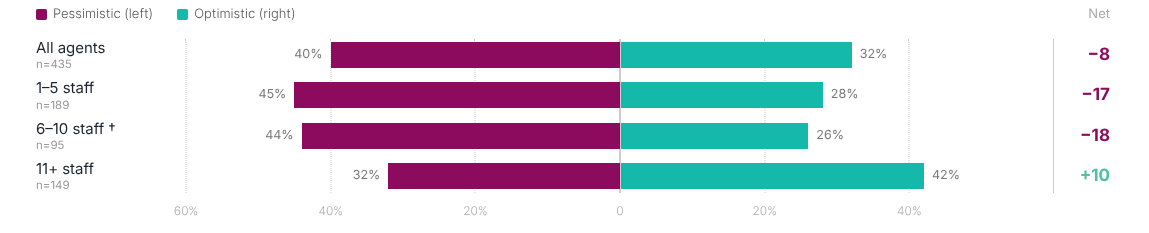
Agency size is the clearest dividing line in the agent data. Among agencies with 11 or more staff, 42% are optimistic about the future of the PRS, compared with 32% who feel pessimistic, a net +10%.
It’s a different story for agencies with five or fewer employees. Just 28% are optimistic, while 45% are pessimistic, giving a net score of −17%. Agencies with six to 10 employees report a similar picture, with a net score of −18%.
This gap was visible before the Act took effect. In our 2025 survey, 44% of agencies with two to five staff said they weren’t prepared for the Renters’ Rights Act, compared with just 6% of those with 11 to 25 employees.
Tom Goodman, Managing Director at Goodlord, warned last year that the changes “would place a disproportionate burden on smaller letting agencies, which often have fewer resources to absorb additional administration.” This year’s findings suggest that concern is becoming reality.
Larger agencies are generally better placed to adapt because they can spread investment in systems and technology across bigger portfolios and draw on established processes and larger teams. Smaller agencies, meanwhile, have fewer people and tighter margins, so the same requirements can take up a much larger share of their time and budget.
Larger landlords are more pessimistic
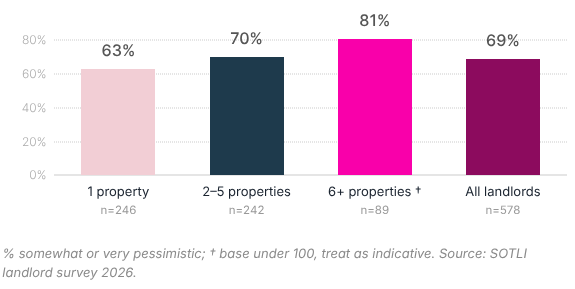
Interestingly, the relationship between size and sentiment works in the opposite direction for landlords. Among landlords with six or more properties, 81% are pessimistic about the PRS. This compares with 70% of landlords with two to five properties and 63% of those with a single property.
The extra work and cost of compliance across a larger portfolio is the likely driver. For instance, among landlords with homes below EPC C, 38% expect upgrades to cost £10,000 or more per property, well above English Housing Survey estimates of £7,040. A landlord with one let faces that bill once; for someone with several, the cumulative cost could be substantial.
This burden could be particularly heavy for landlords who manage their properties themselves, rather than relying on a letting agent. As compliance becomes more taxing, some of these landlords may decide to hand over more of their management responsibilities. For agents, this is a good opportunity to speak to existing clients about the properties they still manage themselves and where they might need a hand.
Younger tenants are the most optimistic
Tenant sentiment has reached its highest level across the four surveys we’ve run. However, here too, things are not as uniform.
Age is the clearest split. Younger renters are the most positive. 50% of tenants aged 25 to 34 feel optimistic about the sector, as do 48% of those aged 18 to 24. By comparison, pessimism reaches 38% among those aged 35 to 54 and 40% among renters aged 55 to 64.
This improvement also has a political dimension. The Renters' Rights Act delivers on a key Labour manifesto commitment to strengthen tenant protections, which helps explain why 27% of tenants believe Labour would have the most positive impact on housing, compared with 4% of landlords and 5% of agents.
However, stronger tenant rights don't necessarily make renting more affordable or ease the housing shortage. 53% of tenants spend more than 30% of their take-home pay on rent, and 39% expect to stay in their current home rather than buy. If these wider pressures remain unresolved, the current improvement in tenant sentiment could prove difficult to sustain.
Confidence in any political party remains low
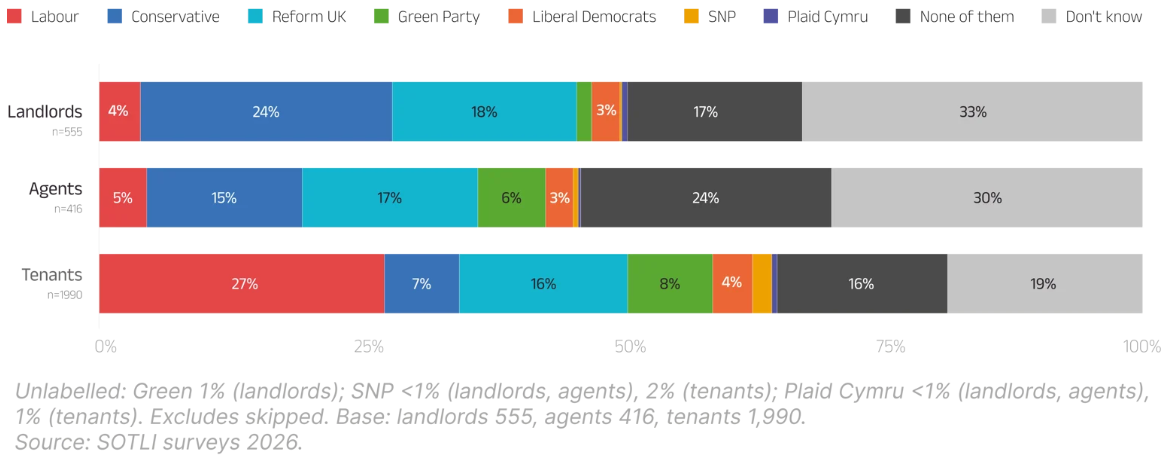
Despite the improvement, net sentiment among agents and landlords remains negative, and many are still critical of the government's wider approach to the PRS. 83% of landlords believe the government is ineffective at listening to them, while 70% of agents say it is ineffective at engaging with their profession.
Around two-thirds of both groups (67% of landlords and 68% of agents) are also negative about the government's efforts to make renting more affordable.
Nor is there much faith in the alternatives. When asked which party they believed would have a positive impact on housing, 54% of agents and 50% of landlords selected either 'None of them' or 'Don't know'. The figure among tenants was 35%, so although they’re the likeliest to favour Labour, more than a third still can’t point to a party they believe would make a positive difference.
Agents and landlords may feel more certain about the rules, but that doesn't mean they feel heard by the people making them. Across all three groups, there’s considerable doubt about whether political parties can address the wider challenges facing the PRS.
Can the sector hold onto its improved sentiment?
While the Act is in effect, its impacts aren’t fully clear. The next phase introduces the PRS database and a new PRS Ombudsman, adding further requirements for landlords and letting agents.
Signs suggest these proposals are already testing confidence. In 2025, agents’ net sentiment towards both the database and the ombudsman stood at +28. By 2026, the ombudsman had fallen to +9, and the database had slipped into negative territory at −13. Support for further reform is weakening as the practical demands come into focus.
The sector has only recently emerged from years of uncertainty surrounding the Renters' Rights Act. If the next phase brings another spell of unclear requirements or changing expectations, it could put this year’s improvement in sentiment to the test.
For now, the PRS Sentiment Index offers a more encouraging picture than last year's results. But greater certainty shouldn't be confused with satisfaction. The challenge is to turn the clarity achieved so far into a more sustainable and confident rental market.
Read the full State of the Lettings Industry Report 2026 to explore the findings in more detail and see what agents, landlords and tenants think about the future of the PRS.