









Average rents in England rose in May, as it remains too soon to say whether the Renters' Rights Act will bring about the turbulence many have predicted
The Goodlord team
Jun 2, 2026
Rental inflation continued to track well below wider inflationary metrics in May, according to the Goodlord Rental Index.
After April’s figures brought about the lowest year-on-year rental inflation in nine months, average rents in May 2026 continue to sit just 1.7% higher than they were at the same point in 2025. This suggests last month’s data was not an anomaly.
By comparison, a year ago in May 2025 rents were increasing 3.6% per year.
Based on thousands of verified tenancy transactions each month, the Goodlord Rental Index captures the actual rents paid, not estimates based on listings/advertisements. These figures reflect confirmed tenant contracts, thereby excluding marketing inflation or any aspirational pricing on property listings.

- Annual rent inflation at lowest level in ten months
- Rents begin to bounce back after April price drop
- London leads the way again
- Analysis from Goodlord CEO, William Reeve
Annual rent inflation at lowest level in ten months
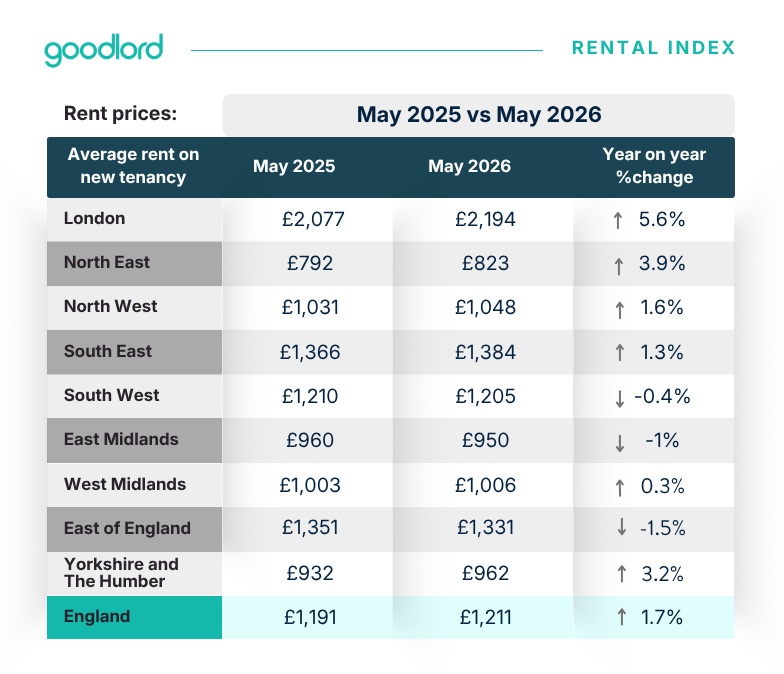
In May 2026, the average cost of a rental property in England was £1,211. For the second month running, this represents just a 1.7% increase on the average price recorded twelve months ago (May 2025), when rents stood at £1,191 per property.
Just as we saw in April, this means the level of annual rental inflation in May 2026 is less than half that recorded during the same month last year, when rents were up 3.6% year-on-year.
April’s figure marked the smallest year-on-year rent increase seen since July 2025. May’s continued low inflation is further evidence of a market that has cooled in recent months.
The new data sees rental inflation continue to sit well below both the latest Consumer Price Inflation figures, which fell slightly to 3% in April, and wage growth, which stood at 3.4% in April.
Despite house building running behind target, net migration fell to its lowest level since 2012 last year, which is likely to be contributing to reduced pressure on rental prices.
Rents begin to bounce back after April price drop
After April saw prices fall for the first time this year, May’s figures show a slight uptick in month-on-month rents.
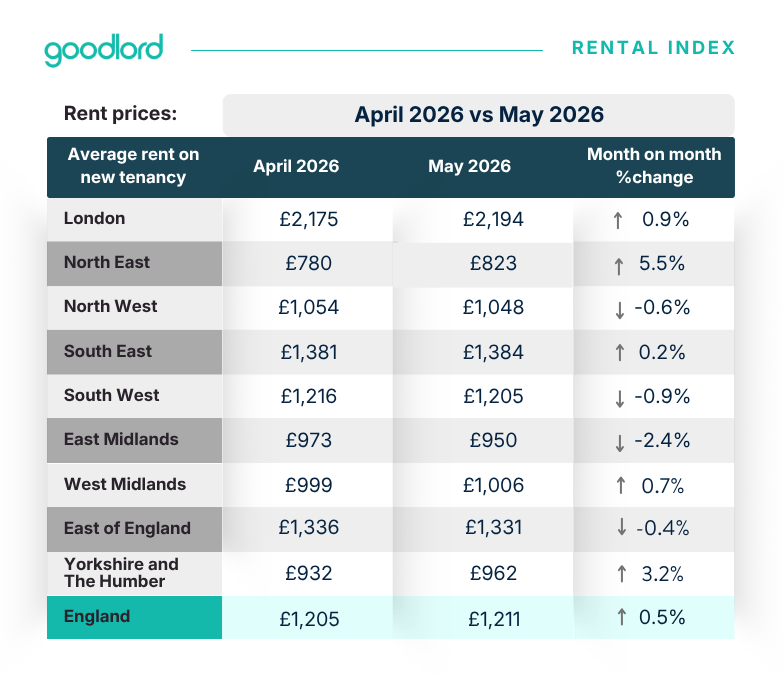
In April rents fell to £1,205. In May, this figure grew to £1,211, representing a 0.5% increase.
Despite this rise, average rents across England remain marginally lower than they were in March of this year, when they stood at £1,212. This makes 2026 the first year since COVID hit the market in 2020 that prices have been lower in May than they were two months earlier in March.
May’s nationwide rent increase was due in large part to prices bouncing back across Yorkshire and the Humber and the North East.
The North East saw rents fall 4.9% in April, but this figure jumped back up with a 5.5% rise in May. Meanwhile, Yorkshire and the Humber saw a 3.2% increase in May, recovering from a 2.8% drop in April.
Greater London, the South East and the West Midlands all saw marginal month-on-month increases, while rents across the East Midlands, East of England, South West and North West were lower in May than they were in April.
In 2025, the month-on-month rental inflation from April to May was 2.1%. This year’s comparatively low rise is reflective of the slow growth we’ve seen throughout 2026 so far.
London leads the way again
After recording the highest year-on-year rental inflation of any region in April (4.8%), Greater London topped the charts again in May. This comes as construction in London stalls, with the capital building just 7% of the 88,000 homes it was targeting last year.
Rents in the capital were up 5.6% in the twelve months to May 2026, rising from £2,077 to £2,194.
Inflation across the North of England had been significantly outstripping price rises seen across the rest of the country in the first quarter of 2026. After cooling off in April, May’s figures for the North East, North West and Yorkshire and the Humber stood at 3.9%, 1.6% and 3.2% respectively.
Having seen a 4% year-on-year increase in April, the East Midlands recorded a 1% drop in annual inflation in May 2026.
Meanwhile, year-on-year rents in the South West (-0.4%) and the East of England (-1.5%) continued to fall last month.
William Reeve, CEO at Goodlord, comments:
“A month on from the introduction of the Renters’ Rights Act, it’s clear the market is still recalibrating. Whether the new legislation will bring the widespread disruption and price volatility many have predicted remains to be seen. Nonetheless, the overall picture is one of a rental sector that has fundamentally changed.
“While average prices have recovered slightly from their drop in April, this is the first time since 2020 that rents in May have been lower than they were in March. These figures reflect a market being pulled in two directions: on one hand, reduced net migration is easing demand-side pressure; whilst the Renters Rights Act and continued underdelivery in housebuilding particularly in London, is constraining supply on the other. How these forces play out over the coming months will be critical in determining the trajectory of rental prices.”